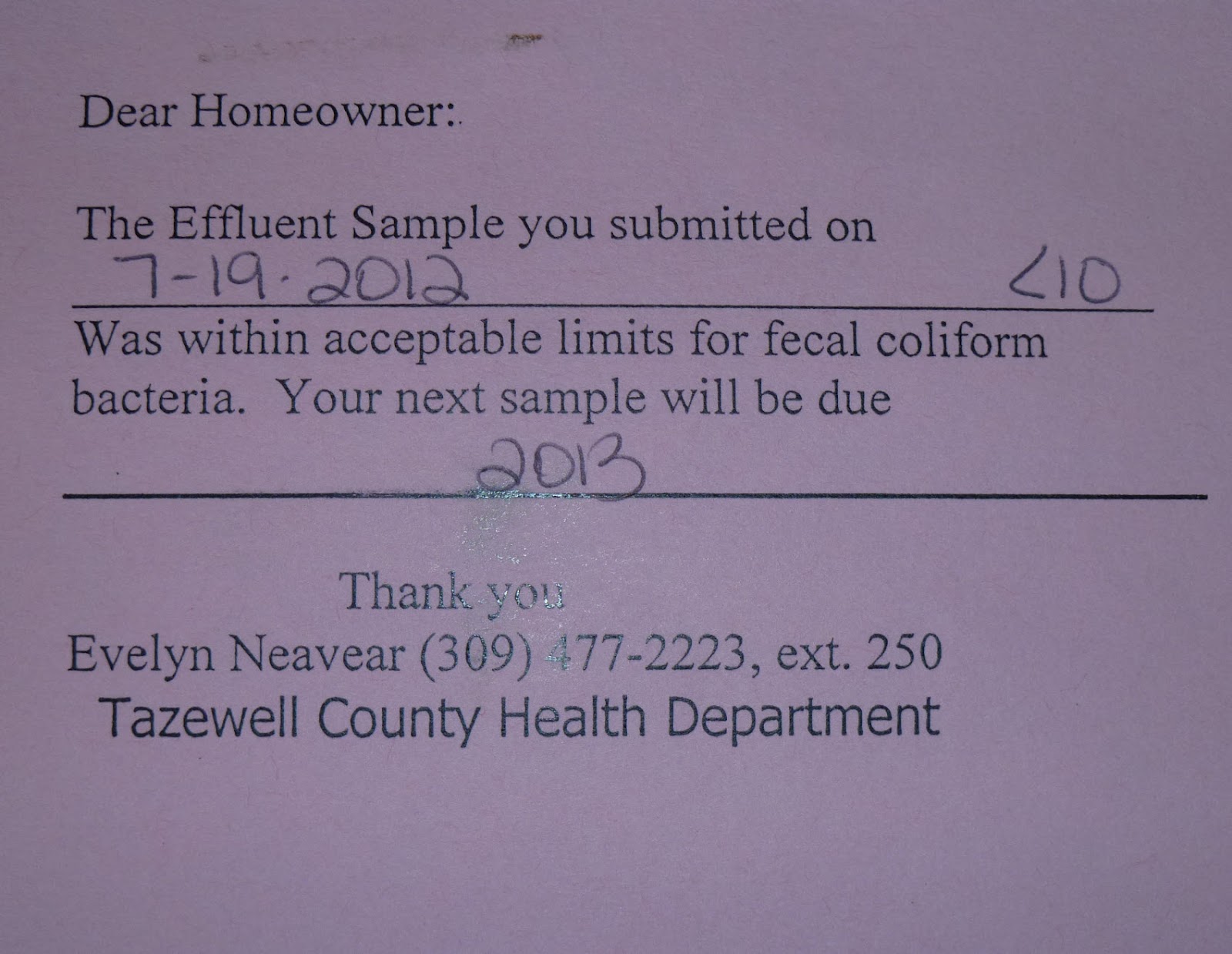
Every year we hope to receive this card from our County Health Department, and this year they didn't disappoint. I've tried to be diligent in the maintenance of our septic system, but I'm always a little anxious when I submit our annual sample. For a summary of our septic experiences over the years, feel free to choose the septic system label in the right column to see all the posts together.
As always, our neighbors downstream are breathing a sigh of relief.
Our family's attempt to present one thing very clever, or two things moderately clever, or three things very dull indeed...
Showing posts with label septic system. Show all posts
Saturday, June 6, 2015
Sunday, July 6, 2014
Thanks for the nice note, Evelyn!
This note from the County Health Department is a welcome relief each year. Given our struggles to obtain this status in the past, a little diligence in the maintenance of our septic system is well worth the effort.
As always, our neighbors downstream are breathing a sigh of relief.
Tuesday, June 18, 2013
In case you were wondering
For all those concerned, here's proof positive that we're doing our part to keep the environment safe downstream. In case you don't know the full story behind this postcard, feel free to read it all here.
Monday, July 30, 2012
I love receiving mail...
...especially when it's good news from the County Health Department.
Once again, our downstream neighbors breathe a sigh of relief.
Thursday, September 29, 2011
Basement Bathroom Project
We have a strange room in our basement. It has two windows, one door, and is about 17 feet long and 5 and a half feet wide. I'm not sure what it was intended for, but I think it's location and size are simply a function of the shape of the house, and the need to support floor joists with basement walls. Although it has served as useful storage for the first few years we've lived here, it always impressed me as wasted space. Until now. Given our desire to add another full bathroom to the house, this awkward little room looked like the perfect location.
Since we didn't really want the sewage ejector in the bathroom, we built a small room for that pump behind the bathroom, and added this doorway so the room could be accessed independent of the bathroom.
There was a good bit of rubble generated by the new door opening, and the floor removal. Our neighbors blessed us by carrying this rubble out of the basement and using it as fill on their own property.
A couple weeks later we had walls framed, plumbing in place, and wires run. The layout of the room is a little more apparent in this shot, as the tub will be placed across the room against the far wall, the toilet next to the tub, and the sink and vanity closest to the camera. The long, thin shape of the room made this galley-type layout one of the few viable options.
This photo was taken from the tub end of the room looking back to the original door. The room was just a little shy of the perfect width, in that the wall studs in the wall on the right were trimmed down a bit so the room width perfectly matched the length of the tub. As you can see, we still had room for standard size electrical boxes, so the construction was not too "nonstandard."
This is the way the room looked when we started tearing into it. In this image the floor has been removed where the plumbing needs to be located, including a sewage ejector pit, and drain for a tub, toilet, and sink. Note the conveniently placed drain pipe on the back wall that runs out into the septic tank in the front yard. What better spot for a sewage ejector pit than right under the drain pipe?
There was a good bit of rubble generated by the new door opening, and the floor removal. Our neighbors blessed us by carrying this rubble out of the basement and using it as fill on their own property.
A couple weeks later we had walls framed, plumbing in place, and wires run. The layout of the room is a little more apparent in this shot, as the tub will be placed across the room against the far wall, the toilet next to the tub, and the sink and vanity closest to the camera. The long, thin shape of the room made this galley-type layout one of the few viable options.
This photo was taken from the tub end of the room looking back to the original door. The room was just a little shy of the perfect width, in that the wall studs in the wall on the right were trimmed down a bit so the room width perfectly matched the length of the tub. As you can see, we still had room for standard size electrical boxes, so the construction was not too "nonstandard."
The tub successfully fit where it was intended.
Meanwhile, behind the tub, the sewage ejector was partially plumbed to pump into the existing drain. At this point, the project was starting to resemble a bathroom, and our hope of eventually enjoying its conveniences was growing stronger. Next time we'll lay out more of the subsequent steps in this project -- you won't want to miss it!
Saturday, November 20, 2010
The nicest thing the county health department has said to me all year:
"Your effluent results were within acceptable limits."
Praise God for sparing me another trip into the depths of the earth. For a better perspective on what I'm talking about, feel free to read our previous posts here.
Tuesday, December 1, 2009
Rejoice with us!
Those who've followed this blog over the past year will realize that the little pink card that came in the mail the other day represents a sizable victory at our house. After multiple tests last winter culminating in a swimming episode in March, and some fishing in the dark at 5:30 AM in October, we thank God that our septic system passed on the first try this fall.
Once again, our neighbors downstream are much relieved.Tuesday, March 24, 2009
Septic System Sampling: The Final Chapter
It is with great joy that we announce the receipt of the postcard pictured above. Even though we only have eight months until we submit another sample, I think the folks at the Health Department have been pretty patient and helpful through our ordeal. We thank the Lord for blessings big and small, and I'm sure everyone downstream is a bit relieved now too.Saturday, March 7, 2009
Swimmin' in the septic system
Regular readers of this blog may remember a post about fishing last September. I described my device for gathering water samples from the discharge of our septic system, and how we are required to submit a sample at least once a year. We submitted a sample last September. It failed. We added chlorine to the discharge and sampled again. It also failed. We flushed the chlorinator and contact tank, added chlorine, and sampled again. It also failed. I've lost count of how many times we've flushed, sampled, and failed, but evidently the County Health Department hasn't lost count. They sent a representative out to take a look on Friday.
Taking a look at the contact tank in our system involves removing about a foot of earth on top of the 24" diameter concrete tank lid, and of course, removing the lid itself. The expert recommended we pump the contact tank, which if everything is working correctly, should only contain relatively clean and clear water. Ours was pretty muddy. After pumping about 40 gallons of water out of the tank, it was apparent that our pump was ingesting sediment, and that we needed a different method to remove water and muck from the tank. Being short on industrial pumping equipment and long on dim wits and energy, yours truly took a bucket into the hole. Even though water continued to trickle into the hole from the inlet and outlet tubes, I was able to stay ahead of the inflow and remove most of the sediment on the bottom of the tank. Photographic evidence of the adventure is included below for your enjoyment.
This was our routine: I would gather as much sediment and water in my little bucket as I could, while Karen's dad lowered a larger bucket into which I could empty mine. Because of the tight quarters, he would need to raise his bucket above my head so I could stoop back down to get another collection, stand up, direct the second bucket down in front of me, empty into it, repeat ad nauseum.
Taking a look at the contact tank in our system involves removing about a foot of earth on top of the 24" diameter concrete tank lid, and of course, removing the lid itself. The expert recommended we pump the contact tank, which if everything is working correctly, should only contain relatively clean and clear water. Ours was pretty muddy. After pumping about 40 gallons of water out of the tank, it was apparent that our pump was ingesting sediment, and that we needed a different method to remove water and muck from the tank. Being short on industrial pumping equipment and long on dim wits and energy, yours truly took a bucket into the hole. Even though water continued to trickle into the hole from the inlet and outlet tubes, I was able to stay ahead of the inflow and remove most of the sediment on the bottom of the tank. Photographic evidence of the adventure is included below for your enjoyment.
This was our routine: I would gather as much sediment and water in my little bucket as I could, while Karen's dad lowered a larger bucket into which I could empty mine. Because of the tight quarters, he would need to raise his bucket above my head so I could stoop back down to get another collection, stand up, direct the second bucket down in front of me, empty into it, repeat ad nauseum.Friday, September 26, 2008
Fishin' in the front yard
It wasn't Hurricane Ike that caused us to go fishing in the front yard, but rather the County Health Department. Because we are the proud owners of a surface discharge septic system, we get to fish in the sample port at least once a year.
Here's my "fishin' pole" fashioned from 1/2" electrical conduit, the bottom of a plastic bottle, and some 12 gauge copper wire (with insulation). This is not an original design, as the septic inspector had something similar when she came out last year. The reservoir can pivot at two places, so it's easier to collect the sample, and pour it into another container.
The fishin' hole.
It's seven feet to the water level in the hole, so it takes good eyes or a light touch to get a nice skim off the top. A flashlight can be helpful too.
That one looks like a keeper! Actually, they were all tossed back (on the ground) when these pictures were taken since I was testing the new pole and skimming off the extra floaties. Don't be too disgusted. Although there could be some bad bacteria that make their way through to the sample port, the water is intended to be clean enough to discharge at this spot.
Subscribe to:
Posts (Atom)


