Showing posts with label Williamsburg. Show all posts

Sunday, January 25, 2015

Colonial Williamsburg at Christmas: A Beautiful Saturday

Our first full day in town on this trip included delightful weather which was about 15 degrees F warmer than average for December 27, and gloriously sunny.  Not surprising then that the crowds in the Historic District were the largest we've ever seen here any time of year.  Combine beautiful weather with the weekend between Christmas and New Years and festive decorations around Colonial Williamsburg, and it's not difficult to understand why others would want to be there with us.

 The decorations around CW are different at each building (as far as we could tell), and usually consisted of a wreath or similar arrangement of natural materials, often including food. Here's an example on one door whose peacock feathers caught our eyes.

Although Bassett Hall is a modest home from the Rockefeller's perspective, I think the main entrance has some elegance and is enhanced by these holiday decorations.

A closer view of one of the arrangements next to the door...

... and a closer shot of the wreath above the door.

This arrangement graced the entrance to one of the taverns.  Apples seemed common to many of the decorations, and often included apples of different colors like in this example.

Finally, lest you doubt the beauty of the weather, I include this shot of the girls approaching Bassett Hall -- beautiful enough to almost make you wish you lived there.

Monday, December 29, 2014

Colonial Williamsburg at Christmas: "Twelfth Night" Performance

We've attended several wonderful concerts in the Ballroom at the Governor's Palace, but we've never seen one of Shakespeare's plays performed there -- until now.  Although there's no record of any theatrical event taking place at the Governor's Palace in the 18th century, this adaptation of Shakespeare's "Twelfth Night" was our first opportunity to see Shakespeare performed in a colonial era setting with 18th century costumes.  I'm glad we went.

Although the play was performed ten times in December, we were unaware of its existence until about a week before we were scheduled to begin our trip.  Karen saw a Colonial Williamsburg blog post that offered two free tickets through a random drawing, and decided to enter.  To her surprise, she won!  The only problem was that we won tickets for a sold-out performance scheduled for the day BEFORE we planned to arrive in Virginia.  Fortunately, our schedule was flexible, so we were able to leave home a day earlier than planned, and made it to town a few hours before show time!

The performance was not a disappointment.  The actors were all very talented, and presented Shakespeare's 16th century language in a way that was relatively easy to follow.  The costumes were nicely executed, and the actors even made some references to the room in which the play was performed.  The fact that we got to visit with most of the cast after the show was simply icing on the cake.  In the photo above, Karen and I are in the middle surrounded by eight members of the cast, and Ralph and Dotty on the right, who also won tickets to the play.

The moral of the story: if you see a contest, enter it!  Especially if entering is free, and the prize is something fun you can't do every day!

Wednesday, January 1, 2014

Colonial Williamsburg in October -- Day 3

Our last full day in the Historic District for this trip was our warmest yet, and even found the locals complaining about the heat.  As you can see below, we found plenty to keep us busy.

We started the day in the gardens of the Governor's Palace where we found Governor Dunmore in a perturbed mood.  Although he was popular among Virginians early in his service, his loyalty to the British crown later put him at odds with a fair number of the colonists he governed.

There won't be any grand photos of the Governor's Palace on this trip as the central cupola was undergoing maintenance and covered by scaffolding for the duration of our visit.

We met this young lady at an English Country Dance on our first evening in town, and were pleased to learn she works as a costumed interpreter in Colonial Williamsburg.  Dara works mainly in retail establishments in the Historic District, and we found her working in the Post Office this day ever ready to meet our shopping or conversational needs.  We'll keep our eyes peeled for her smiling face on future visits.

These two gentlemen are working on the tent project mentioned earlier.  The tailors were commissioned to reproduce George Washington's marquee, or camp tent, as the extant article can only be displayed in very controlled conditions.  Mark Hutter hired seven "tent stitchers" to assist with the hand sewing, and although the replica was not ready for display when we visited, it has been displayed since and will be available for visits at the Museum of the American Revolution when that facility is built.

This 1/6 scale model of the tent illustrates the separate compartments that comprise the entire structure.  The inner tent was likely Washington's private field office and measured about 8' by 10'.  The curtain hanging from the valance of the larger tent was attached all the way around the periphery and formed semi-circular areas at each end.  It's postulated that General Washington slept on one end and his baggage and servants were settled at the other end.  You can learn more and see more details on CW's First Oval Office page.

We've enjoyed chatting with Max Hamrick, Jr. during many of our visits over the years, as he's developed our appreciation for the weaving craft displayed in the Historic District.  I believe Mr. Hamrick has been the weaving and dyeing expert here since 1988, and he informed us on this visit that he intends to retire soon and leave the weaver's shop in the capable hands of Karen Clancy and her apprentices.  We suspected at the time, and have confirmed since, that this would be the last time we would visit with Mr. Hamrick in this manner.  May your retirement years be many and fruitful, Mr. Hamrick!

This room is part of the oldest academic structure in America, the Sir Christopher Wren Building on the campus of the College of William and Mary.  The college is located just west of the Historic District, and since it's important in the history of colonial Williamsburg, a visit here is a natural extension of a visit to CW.  This main hall was part of the original structure, but since the building has been modified after each of its three fires, this room may not have had this appearance when first constructed in 1695.  Even so, I wonder if the windows were inspiration for J.R.R. Tolkien in the 20th century...

On our way back east on Duke of Gloucester Street we encountered the Fife and Drum Corps marching west.  Thomas Baker assumed the role of lead fifer, and I even sighted Mark and Cookie Baker walking along with the Corps.  Unfortunately, there wasn't time for a visit since we were already late for our dinner reservations.  It was a sad moment waving to the Bakers from across the street, unable to attract their attention.

Good things were waiting down the street, however.  Dinner at Shield's Tavern was a special treat and an appropriate prelude to our evening's entertainment...

... a Capitol Concert featuring 18th century (or earlier) music performed by The Governor's Musick.  My seat was on the far end next to Karen, nearly rubbing elbows with Wayne Moss, the viola da gamba player (on the far left).  Just in front of my seat is the chair occupied by Herb Watson, the flutist.  None of the seats are bad in the Capitol, but we were honored to truly be in the "spit zone."  More than an hour of lovely classical music was the perfect way to end this visit.

Saturday, December 7, 2013

Colonial Williamsburg in October -- Day 2

Our second full day in the Historic District found us visiting some familiar sites and experiencing something new: our first social call to the private home of a CW interpreter!

We started our day with a lively conversation with the printers in the Printing Office.  Since we were the only visitors to the shop for about 15 minutes, we had their undivided attention.

Here's the copy of the Virginia Gazette that was being printed that day, complete with ink blob imperfections (see the "g" in "accordingly" in the last line of the first paragraph in the middle column).  The printer showed us how he brushes dirt or debris from the type before the next page is printed.

The highlight of the morning was tea (and coffee) at the Walker residence next door to the Peyton Randolph House.  As you might recall from a previous post, we met Brett Walker on Duke of Gloucester Street not far from his shoemaker shop last April, and later met some of his children on Market Square.  They graciously extended the invitation to come visit on this trip, and we all enjoyed the chance to chat and get to know each other a little better.  That's Mr. Walker leaning against the door frame behind Karen, and Levi between the door and window on the other wall.  More evidence of how small the world is: some of the Agnew children had attended Mrs. Walker's mother's Sunday School class when the Agnews lived in Michigan years ago.

This quaint garden on Duke of Gloucester Street near the Nursery was exhibiting nice color even in October!

We were happy to introduce the Agnews to Bassett Hall (the Williamsburg home of the Rockefellers) as the home represents quite a few eras and has some attractive features.  Pictured here is the formal living room.  The colors may not be our first choices, but the home still feels very comfortable.

The gardens at Bassett Hall include this bench that appears to be perfect for photographing five lovely ladies at the same time.

Our afternoon also included a review of the troops conducted by the Marquis de Lafayette.  The intense look in his eyes is typical of Mark Schneider's interpretation of the major general, but we have always found him to be very kind and courteous when encountered on the streets of the town.

Finally, a nicely framed portrait of Jaclyn and Katie at one of our favorite garden gates.


Sunday, October 27, 2013

Colonial Williamsburg in October -- Day 1

If you've read our previous posts about Colonial Williamsburg, you already know we like to visit in the spring, and you already know we like to enjoy the sites and people of CW in the company of good friends. Although it isn't spring, we were confident October would still be pleasant, and this time half of the Agnew family agreed to join us for a three-and-a-half-day tour of the town.

This photo of four lovely young ladies is out of order with the chronological progression of our day, but it gives you a good introduction to the younger generation of our group. You might recognize the setting as the garden behind the Wythe House.

We arrived on a Tuesday near lunchtime and after completing a few stops outside of CW, we purchased passes and concert tickets for later in the week, and had time for a stroll on Duke of Gloucester Street in our "modern" attire. Wednesday was our first full day in costume, and we started the day in the Palace gardens followed by a tour of the house. This attractive desk in the receiving area just inside the entrance makes one want to pen a letter. As I enlarged the photo above to examine the document most prominent, I could almost read enough to understand its purpose -- almost. If it's sitting out again the next time I'm in the Palace, I'll have to zoom in as close as possible to get a better shot. A railing prevents one from access to all corners of the room, but I think I can improve on this picture.

This room in the Palace is just outside the ballroom and is the perfect place to address any deficiencies in one's wig before making your appearance for the evening. I'd never paid much attention to this room in the past, but I'll have to watch for changes in the items on display here in the future.

This small building attached to the Robert Carter House by this covered walkway is the McKenzie Apothecary.  The railing design is eye-catching and yet looks fairly easy to duplicate. Combine that with the dormer on the front of the roof, the external chimney, the short staircase rising to the walkway, the multiple rooflines, the brick foundation for the walkway, and several other features you can't see in this view, and you've got a very special little structure.

This basket weaver was hard at work behind the Wythe House gardens producing sturdy and functional white oak baskets of all sizes. The scraps on the ground indicate there is sometimes a good bit of waste in the process of preparing a piece of wood for use in a basket.

Although it was the beginning of October, the weather was warm and dry, and the Wythe House gardens hadn't given up for the winter yet.

Our day included a visit with Michael in the Millinery where he was as happy as always to show us his recent projects. The white riding habit in the foreground with the blue waistcoat was constructed with a familiar tailor's style, while the red and green coat just in front of him is constructed with features more familiar to a mantua maker. I was impressed with the striped velvet under the white coat, and could imagine myself in a suit made from that fabric.

A visit to the silversmith is always interesting, although this apprentice was busy enough with other questions that I didn't have opportunity to ask my own.  Maybe next time.

We were happy to join the Agnew ladies on their inaugural visit to R. Charleton's Coffehouse.  Unfortunately, the cups are always too small and the time allowed too short.  I guess that means one simply needs to come back frequently.

We also stopped to see how construction of George Washington's tent was progressing (more on this project in a future post), and found Mark Hutter, the head tailor, taking a break outside the building.  This was one of the few times we've seen Mr. Hutter attired in something other than 18th century clothing, and he was kind enough to entertain our questions and share stories with us.  The tent project has been consuming most of his time for months, and he expects to have it completed by the middle of November.

Our evening ended with a Williamsburg dessert tradition: "Death by Chocolate" from The Trellis Restaurant. After introducing the Agnew ladies to this delight, they agreed that it was worthy of repeating.

Wednesday, May 22, 2013

Colonial Williamsburg 2013, Day 6

Our last day in Colonial Williamsburg on each trip is always bittersweet, and this visit was no different.  That did not prevent us from cramming as much into our day as possible, so here are a few highlights.

We started the day at the Powell House, which is popular for the 18th century games and activities available in several rooms. Tara was familiar with mancala and is instructing Lily in this shot.

Meanwhile, Karen and Gretel took up a game of checkers.

Our visit to the printing shop included an explanation of this set of cases that hold the cast metal sorts that are combined as movable type to print documents. I don't think I ever noticed before, but the capital letters are in the upper case and the smaller letters are in the lower case.  Get it?  Upper case and lower case.  I guess I'm easily amused.

Our afternoon included a tour of Bassett Hall which was once the Williamsburg home John D. Rockefeller Jr. and his wife Abby Aldrich Rockefeller. I've shown some pictures from this house in at least one previous post, but the house has several interesting features that warrant further consideration.  The room shown above is the master bedchamber decorated with some of the Rockefeller's favorite art and figurines.

The early flowers were blooming in the backyard to make for a pleasant (but hot) garden tour.

Next stop: the George Wythe House.

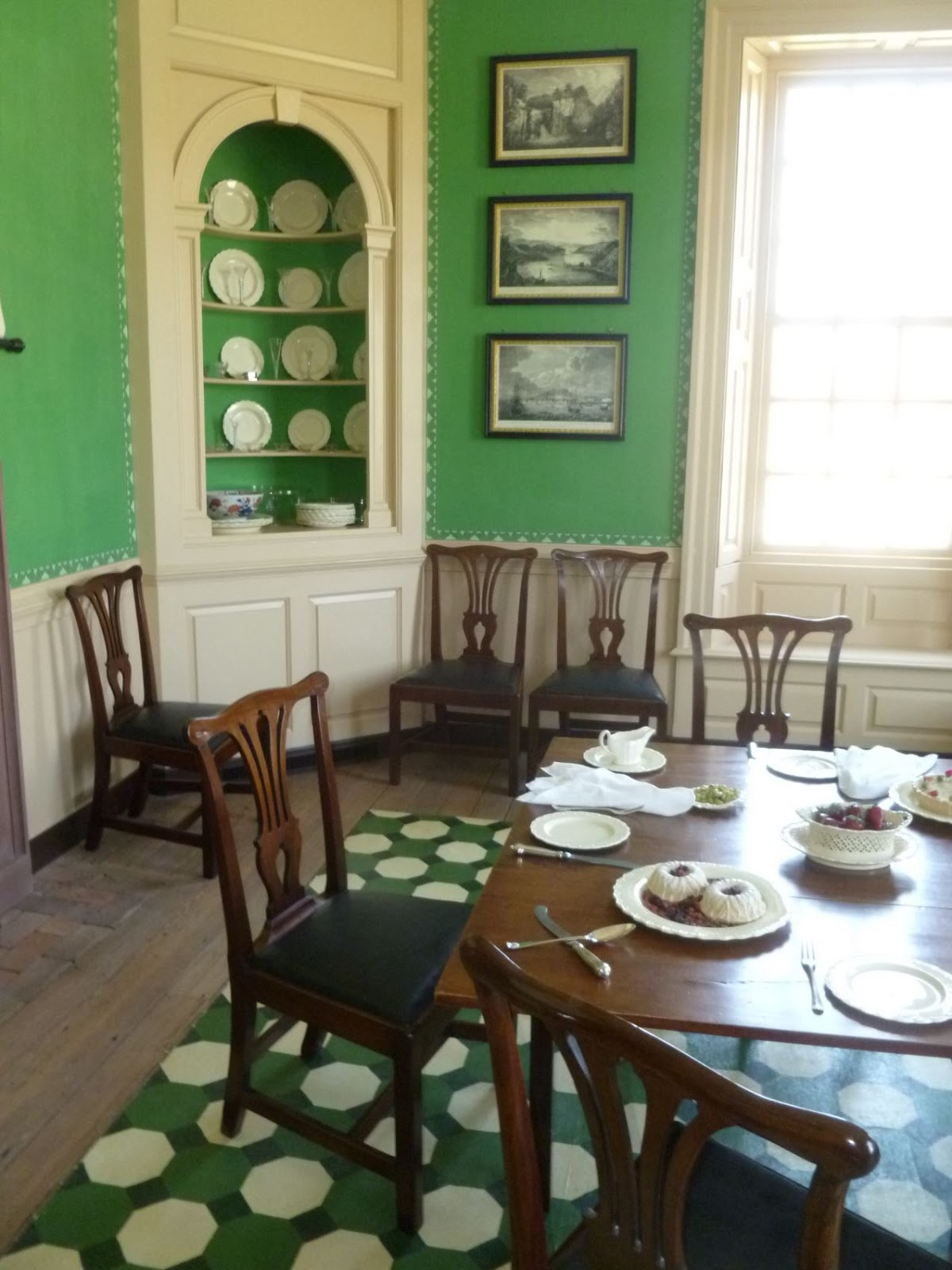
I don't recall if I've ever shared an image of the dining room in the Wythe House, but it is certainly eye-catching!  Even though it may not be my favorite decorating scheme, it has a tasteful charm that kind of grows on you.

Proof positive that Tara got a chance to play the reproduction harpsichord in the cabinetmaker's shop.

This little outbuilding caught my eye and reminded me of the playhouse I built several years ago for my daughters.  Not that our playhouse shared a lot of features with this building other than approximate size and proportion.

As the afternoon winds down and we realize these are our last moments on Duke of Gloucester Street for this trip, we can't pass up the opportunity for a fashionable shot of our lovely young ladies.  These memories will have to suffice until we can return again to Colonial Williamsburg.

Saturday, April 20, 2013

Colonial Williamsburg 2013, Day 5

Our fifth day in the historic city started hot and sunny, so we found ourselves seeking shade whenever possible, which was not easy because many of the trees had not yet sprouted leaves.

Patrick Henry took it all in stride when he addressed an audience in the Palace garden to discuss his faith and the role of religion in society.  Although we've heard him address the topic several times before, listening to him express his beliefs and answer questions is always entertaining.

By day five the Palace garden was noticeably more colorful than it was five days earlier although you may have to enlarge this image to appreciate the colorful blooms.

We found the cook in the Palace kitchen busy cutting butter into flour to make breads of various shapes.  The completed dishes in front of him included a couple puddings, a stuffed cabbage, veal kidney, salat with egg and several other dishes of which I can't remember their identity.

Although you can't see their faces well, one can appreciate our ladies' gowns on this stroll along Prince George Street.

We sought refuge from the afternoon heat listening to Ron Carnegie portray George Washington at the Kimball Theatre.  I don't recall hearing Mr. Carnegie in a question-and-answer format before, but this presentation was consistent with the Washington speeches we've heard him deliver during Revolutionary City events.  He portrays an unanimated President Washington, which may be accurate compared to Patrick Henry or even Thomas Jefferson, but when it comes across as condescending it quickly grows tiresome.  Not a favorite, but I'll probably give him another chance in the future.

Our tour of the Everard house found few changes from our last visit, but that doesn't prevent me from sharing a couple photos and a bit of information.  I've shown these dishes in a previous post but they were on a table and hard to see.  As mentioned before, these dishes were recovered from a shipwreck after they had spent over 230 years at the bottom of the South China Sea.  A representative of Colonial Williamsburg recognized the pattern when they came up for auction in China several decades ago, and spent quite a bit of money to obtain many of the pieces shown here.  The pattern is identical to that found on dish fragments discovered in excavations around town, so the curators here are confident this pattern of dishware was used in this town in the colonial period.  I'm told China is much more restrictive in what they allow to leave the country now, so that providential auction may have been the opportunity of a lifetime.

The Everard House kitchen stands to the left and the smokehouse to the right in this photo.  Both structures are original and restored buildings that stood on the property in the mid 18th century.

Moving on to the Governor's Palace, the color of the paneling on the south wall of this comfortable little study caught Karen's eye.  She's been thinking about a different blue for our kitchen at home, and although this color may not make the final cut, we think it's pretty nonetheless.

Dinner before our concert in the evening was at Christiana Campbell's Tavern.  Since they specialize in seafood, most of us tried dishes based on local and non-local catches.  We found each selection enjoyable, and would recommend this restaurant.

On our walk across town to the Governor's Palace for the concert I couldn't resist this shot of the cupola and flag above the Capitol Building in the fading evening light.