Showing posts with label food. Show all posts

Thursday, June 11, 2015

The Cherry Harvest Has Begun!

Other than picking a few cherries for nibbling here and there, we didn't really start harvesting until June 9. We've had a few friends collect about 3 gallons of cherries off the tree so far, but there's still plenty left to pick. As best I can determine, the variety is probably Montmorency, as the fruit is never huge or dark, but ripens to a moderately deep red. The taste is sour, but still pleasant to eat off the tree, and makes a wonderful cooking cherry. If any of our readers would like to come pick to their heart's delight, just come on over and help yourself. We have ladders available, and if you come while we're  home, we may keep you company while you pick!

Sunday, March 22, 2015

Maple Sap Harvesting

Our neighbors had good success last winter harvesting maple sap and converting that to syrup, so we all anticipated the products of this year's harvest. Even though the trees were tapped a week earlier than last year, the weather this year has not been as ideal for producing lots of sap.

The sap flows best when nighttime temperatures are well below freezing, and daytime temps are well above freezing, preferably with some sunshine thrown in. Prior to March 6, the temperatures tended to be too cold, but the forecast for that day and those following looked promising enough to put Philip and his sidekick Josh into action. I didn't see Josh helping with the tapping last year, so I presume he was in training when they stopped by our house this year. In this shot it appears I distracted Josh from his responsibilities.

With all three of our trees tapped, the guys were ready to move on to the next target.

Unfortunately, the weather has tended to be too warm most of the nights over the last two weeks, so the sap hasn't been flowing as well as it did last year. This picture shows the first 24 hours of production on one of our trees that had two taps running into this container. The low temperature that first night was 29°F while the high the next day was 51°F. There appears to be a little less than a gallon in this jug since I think the container holds about 5 gallons when full.

After 48 hours the container appears to be over half full. The low hit 27°F the night before, and 51°F again during the day, so conditions were sufficient to keep a decent flow of sap moving.

We've had a few good days since, but more poor days than good ones so far. It appears that the sap production may be lower than last year's harvest, which means the syrup may be in shorter supply. Our neighbors have boiled down a couple of batches of sap in the last two weeks, producing about 9 gallons of syrup which is a far cry from last year's total.  Although the near term forecast doesn't look ideal, the maple syrup season may not be done yet!

Saturday, March 14, 2015

Happy Pi Day 2015!

Once every century our calendar and clocks order themselves in such a way to duplicate more than just a few digits of pi (the number representing the ratio of a circle's circumference to its diameter). Using American dating format, today's date is 3-14-15 which is the first four digits (not including the 3 on the left side of the decimal), and only occurs every 100 years. If one includes the time of day, we could represent 9:26:53 which would give us another 5 digits.  Since seconds can be represented with fractional parts, we could technically represent an infinite number of pi digits: 3-14-15 9:26:53.589793238462643383... I think you get the idea.  We'll stop at nine digits today and be happy with that.

To celebrate, we ate three pies for supper this evening as shown in the photos below. 

The overview of the table before we began this evening.  Not visible in this view is the bunting that crossed the room five times. It added an air of festivity to the celebration, but alas, it wasn't directly related to the number pi.

Our first course was this Chile Chicken Potato Pi decorated with the first 15 digits of pi on little banners around the rim of the pedestal supporting the pi. This was our first try for this recipe, which received thumbs up from the family and will be repeated again some day!

The first dessert course was this Chocoroon Pi that is a family favorite.

Costco provided the second dessert course with their jumbo Apple Pi. We had one of these a few months ago, and found it to be one of the best apple pies we've ever tasted, hence it's appearance on our table again tonight. At 75 ounces, this monster would challenge any contestant at a pie eating contest!

As I'm writing this, it occurs to me that there was one moment in history when the date and time matched pi even better than today: March 14, 1592, at 6:53:58. I guess we'll have to content ourselves with the second most significant celebration of Pi Day.

I'm also aware that some guides to the Greek language suggest pi should be pronounced "pee." When considering celebrating this important number, I'd rather trust the common modern pronunciation than spend more than a few seconds contemplating celebrating per the other pronunciation.

Saturday, June 28, 2014

A bumper crop of cherries

I'm always anxious each year to see how many blossoms appear on the cherry tree, as that's one indicator of the fruit yield for that year.  A lot can happen between the budding of the blossoms and harvest of the fruit, but without blossoms, there's no hope for fruit.

Imagine our pleasure this year to see the tree covered in flowers like this on May 4.  I'd been impressed for a week before this as the blossoms seemed to proliferate daily, until by the beginning of May I started being anxious about freezing temperatures.  We've occasionally had frozen flowers on the tree, which kills them in short order and eliminates any hope of fruit at that bud.  Once the flower is pollinated, and the fruit begins to set, freezing is less damaging although we've seen some yield reduction at that stage in the past also.

I checked the fruit periodically in May and was disappointed that a noticeable number of blossoms did not appear to have been pollinated.  I hadn't noticed any bees around the tree this year as in years past, but I wasn't watching closely either.  Was I seeing evidence of shrinking bee populations?  Evidently the bees did a better job than I expected, as the fruit proliferated over the months of May and June at a rate not a lot slower than the blossoms.

God blessed us with no freezing temperatures from blossom to fruit ripening this year, so our crop was the largest we've seen on this tree.  This is how the tree looked on June 18 after about a gallon of fruit had been harvested already.  Knowing the amount of work involved in picking and pitting that many cherries, and how there were far more than we normally consume, we put the word out to friends to come help themselves and many helped and enjoyed the fruits of the harvest this year.  Since we didn't measure the yield we can only estimate that over eight gallons have been harvested so far.

This image proves it was not difficult to find cherries to pick this year.  I don't have measurements to prove it, but it appears the fruit is a little smaller this year than in the past.  Is that a reflection of the limited rainfall we received while the fruit matured?  Or maybe the tree can only produce so much volume of fruit, so if there are more cherries, they end up smaller?  Someone smarter than me will have to answer those questions.

Ultimately, this is the goal: fruit safely off the tree and ready for processing or immediate consumption.  In the end, we have enough cherries for our satisfaction and at least six other families will benefit as well.

Friday, April 18, 2014

Central Illinois Maple Syrup

I realize Vermont is better known for its maple syrup, and Quebec supplies much of what the world consumes, but that doesn't stop our neighbors here in Central Illinois from doing their part to meet mankind's demand for real maple syrup.  Last year we watched in admiration as our farmer neighbors tapped dozens of trees around our neighborhood, and spent the time and money necessary to gather hundreds of gallons of sap to boil down to dozens of gallons of syrup.

This year, when they offered to tap the trees in our front yard, I quickly encouraged them to do so, and within a few hours, our trees were contributing to the harvest!

Here's Thad and Philip drilling the holes and setting the taps.  The number of taps was determined by the size of the tree.  Two of our trees could accommodate three taps, while one tree was best left with only two.

The arrangement in our yard had at most two taps running into one five-gallon jug, meaning we had five jugs total receiving sap.  The sap is very watery, unlike pine sap, so the taps, lines, and jugs don't clog easily.

The critical operation of boiling to sap down to syrup was begun on this fine example of Steiner ingenuity and manufacturing.  The half-barrel stove box on the bottom was reinforced and improved this year based on lessons learned last year.  The blower and ductwork in the foreground force air into the combustion chamber to insure that the fire has adequate oxygen to burn vigorously, while the door on the stove above the ductwork allows access to add wood as needed.  The vertical boards just downstream of the blower serve as a damper to better control the air flow.  Hot exhaust gases exit through a vertical chimney at the far end.

The main pan on the stove is a custom-built, stainless-steel unit about seven inches deep that holds about five gallons per inch of depth.  It's fed by a smaller pan in the background that preheats the cold sap before it's added to the main pan.  That ensures the main pan maintains a constant boil throughout the many hours it takes to boil a batch of sap.

How big is a batch of sap?  This year, the Steiners commonly boiled 200 gallons of sap at a time, that would yield as much as eight gallons of syrup.  That 25:1 ratio is very low for maple syrup, and can be as high as 40:1.  In this photo, about 150 gallons of sap waits to be boiled, although not all of it was included in this batch.  (The washing machine in the background was not used in preparation of the syrup).

Syrup is judged complete when the temperature reaches the proper value.  In this photo you can see the syrup was a lovely brown color while the temperature was well above 216°F.  Several more gallons of sap were due to be added to this batch and boiled down before the near-syrup was transferred to the house kitchen stove for finishing.

The total harvest for our neighbors was about forty gallons of syrup this year, which exceeded last year's total.  Our trees contributed about 40 to 50 gallons of sap in the three weeks that they were tapped.  The whole process is very labor-intensive, so it's easy to understand why real maple syrup is so expensive, but when waffles or pancakes are on the menu, nothing compares to real maple syrup, especially when it comes from your front yard!

Saturday, April 20, 2013

Colonial Williamsburg 2013, Day 5

Our fifth day in the historic city started hot and sunny, so we found ourselves seeking shade whenever possible, which was not easy because many of the trees had not yet sprouted leaves.

Patrick Henry took it all in stride when he addressed an audience in the Palace garden to discuss his faith and the role of religion in society.  Although we've heard him address the topic several times before, listening to him express his beliefs and answer questions is always entertaining.

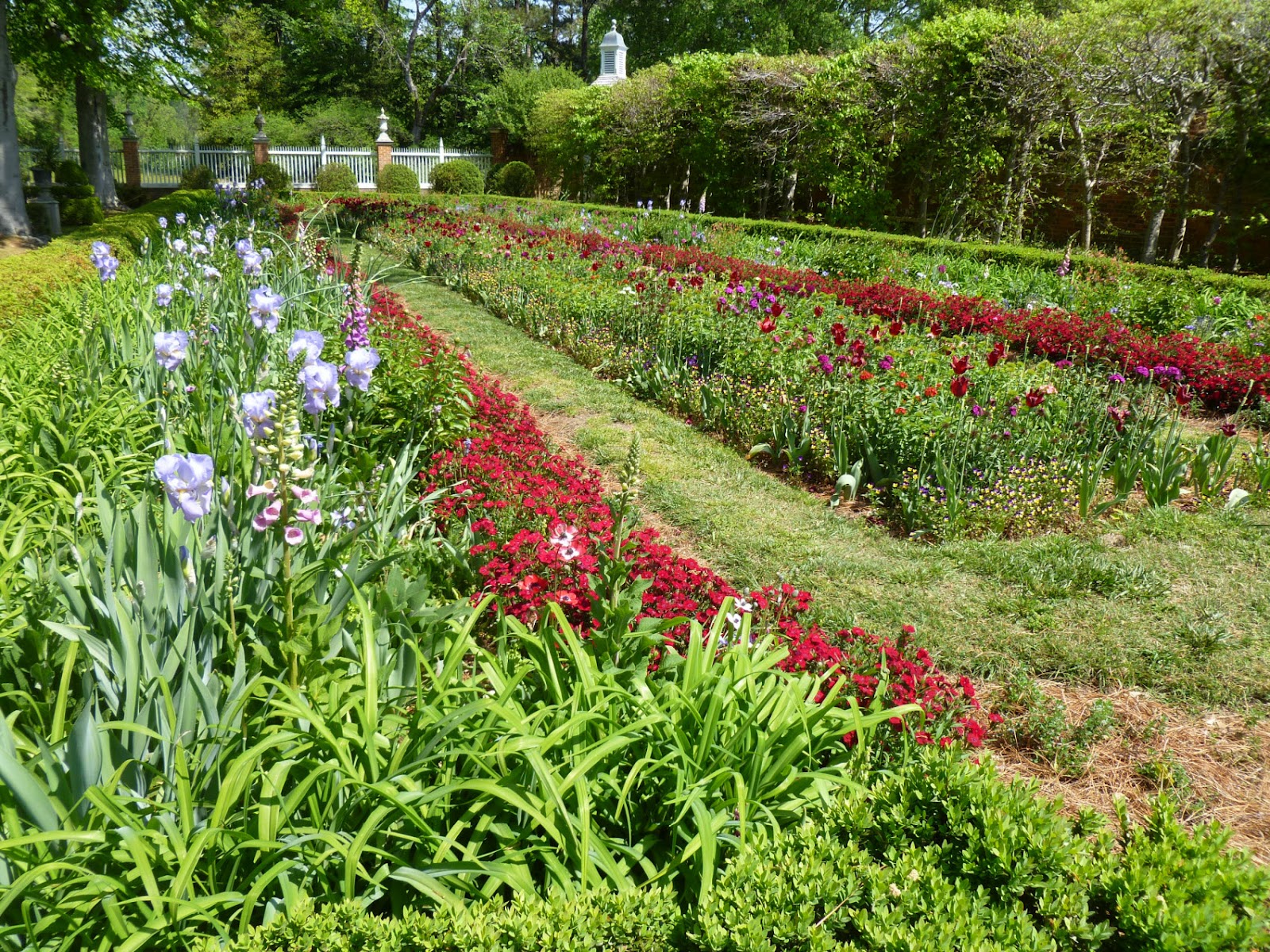
By day five the Palace garden was noticeably more colorful than it was five days earlier although you may have to enlarge this image to appreciate the colorful blooms.

We found the cook in the Palace kitchen busy cutting butter into flour to make breads of various shapes.  The completed dishes in front of him included a couple puddings, a stuffed cabbage, veal kidney, salat with egg and several other dishes of which I can't remember their identity.

Although you can't see their faces well, one can appreciate our ladies' gowns on this stroll along Prince George Street.

We sought refuge from the afternoon heat listening to Ron Carnegie portray George Washington at the Kimball Theatre.  I don't recall hearing Mr. Carnegie in a question-and-answer format before, but this presentation was consistent with the Washington speeches we've heard him deliver during Revolutionary City events.  He portrays an unanimated President Washington, which may be accurate compared to Patrick Henry or even Thomas Jefferson, but when it comes across as condescending it quickly grows tiresome.  Not a favorite, but I'll probably give him another chance in the future.

Our tour of the Everard house found few changes from our last visit, but that doesn't prevent me from sharing a couple photos and a bit of information.  I've shown these dishes in a previous post but they were on a table and hard to see.  As mentioned before, these dishes were recovered from a shipwreck after they had spent over 230 years at the bottom of the South China Sea.  A representative of Colonial Williamsburg recognized the pattern when they came up for auction in China several decades ago, and spent quite a bit of money to obtain many of the pieces shown here.  The pattern is identical to that found on dish fragments discovered in excavations around town, so the curators here are confident this pattern of dishware was used in this town in the colonial period.  I'm told China is much more restrictive in what they allow to leave the country now, so that providential auction may have been the opportunity of a lifetime.

The Everard House kitchen stands to the left and the smokehouse to the right in this photo.  Both structures are original and restored buildings that stood on the property in the mid 18th century.

Moving on to the Governor's Palace, the color of the paneling on the south wall of this comfortable little study caught Karen's eye.  She's been thinking about a different blue for our kitchen at home, and although this color may not make the final cut, we think it's pretty nonetheless.

Dinner before our concert in the evening was at Christiana Campbell's Tavern.  Since they specialize in seafood, most of us tried dishes based on local and non-local catches.  We found each selection enjoyable, and would recommend this restaurant.

On our walk across town to the Governor's Palace for the concert I couldn't resist this shot of the cupola and flag above the Capitol Building in the fading evening light.

Sunday, April 7, 2013

Colonial Williamsburg 2013, Day 2

Our second full day dawned sunny and cool, and found us in the Historic District almost all day.

Our first appointment of the day was a conversation with Thomas Jefferson on the Palace grounds, but since we arrived early, we decided to take a turn or two around the property.  There really are four girls strolling around the lagoon in this picture, even though you'll need a sharp eye to spot them all.

Several others joined us in our chat with President Jefferson in the year 1812, as he shared his views on religion and its relationship to the state.  Among other things, he made it clear that he envisions a wall of separation between church and state in that each has its own jurisdiction and the state shall not demand allegiance to any religion; he was incredulous that some would construe this to mean that morality based in religion should have no place in the affairs of the state.  Overall, the conversation was an interesting display of  Bill Barker's interpretation and portrayal of Jefferson's views on religion in general.

Equally interesting and always entertaining is Richard Schumann's portrayal of Patrick Henry.  Our engagement with Henry included a large audience in the Hennage Auditorium and addressed primarily affairs of state, which were strongly voiced.  Come to think of it, I can't remember Patrick Henry having anything but strong opinions on any subject!

Since spring is relatively late here, a few trees have flowered, although many are yet to bloom.  The bee harvesting in this blossom caught my eye and reminded me of beekeeper friends in Central Illinois.

A chat with the weavers is always instructive and entertaining as today we learned about bed rugs (a few samples displayed in the foreground) while the master weaver busied himself with the loom in the background.

An auction of Colonial Williamsburg wares was held in the Market Square this afternoon, and here Karen proudly displays the spoils of her victory with Kathryn and Gretel.

Although she was a temporary stand-in for the journeyman apothecaries, this interpreter did an excellent job of answering our questions.  Too much television in my childhood enabled me to follow her impersonation of Johnny Carson in her description of some the store's wares.

Although we had 20th century food for lunch, we managed to find ourselves back in the 18th century at dinnertime at the Kings Arms Tavern.

Here's our party ready to dive in to the delicious repast of several colonial favorites.  The Yen family from Northern Illinois has joined us this year for a celebration of all things colonial, in what promises to be an enjoyable week at our second home.

Wednesday, April 3, 2013

Cream Tea Shootout: Devon vs. Cornwall

Cream tea is a delightful English invention that makes just about any day seem special.  Combine fresh brewed tea (served with milk) with scones, clotted cream, and strawberry jam, and your taste buds will have a little party in your mouth.  The folks of Devon claim to have enjoyed the first cream tea, so when we found ourselves in that part of the country, we naturally searched for the finest tea shop in the county and enjoyed Devon cream tea.

Devon cream tea is properly eaten by splitting the scone in two and spreading clotted cream on each half before strawberry jam is added atop the cream.  That's the way we prepared our treats at Primrose Tea Rooms and the experience was one of the most enjoyable of our trip.  The proprietress was congenial and seemed surprised that we would pick her shop out of all the tea rooms in Devon based solely on reviews posted on the internet.


We were well aware that Cornwall also boasts exceptional cream teas, so two days later we treated ourselves to a late afternoon Cornish cream tea at Pengenna Tea Room in Tintagel.  Cornish cream tea differs from Devon cream tea in at least one important aspect: the jam goes on the scone before the clotted cream.  The picture above was taken in Cornwall, so you can see the scone at my place properly prepared with the jam on the bottom and the clotted cream on top.

The creaminess or spreadability of the clotted cream may determine whether you choose to prepare your scone in the Devon style or the Cornish style.  Stiffer clotted cream requires some friction between the cream and application surface, and if that surface is covered with slippery jam, the Cornish method can be difficult to implement.  While fresh baked scones and locally prepared clotted cream and jam should result in tastier cream tea, we found several factory made ingredients that tasted wonderful, leading us to hesitate turning up our noses at plastic tubs.

Which cream tea is superior?  That's hard to determine.  The experience is primarily a sum of its parts, in that the quality of the scones, clotted cream, and strawberry jam are all important variables, not to mention the supporting role of the beverage.  We found excellent ingredients in many different parts of the country, and felt unable to judge one county superior to another based on our limited samples.  Therefore, we volunteer our services to complete more sampling in the future.

Sunday, May 20, 2012

More food crops around the yard

Most of our readers are probably familiar with the unusual weather we've experienced this spring, and some may have first-hand knowledge of its effects on different crops.  I was especially concerned about our cherry tree as it bloomed in March, about a month earlier than normal.  Our temperatures were especially warm through much of March, but the inevitable freezes hit again in April.  Since our cherry crop was reduced at least 95% last year due to freezing, I was anxious our experience would be similar this year.

As you can tell from the photo above, we have a crop!  The blossoms had faded and fruit was beginning to form by the time the freezes hit our yard, so apparently the fruit is more robust to cold temperatures than blossoms are.  The crop appears to be about 70% of the size of a bumper crop, but we're grateful for even a harvest of that size.  We're hopeful the fruit will continue to mature without further damage from weather or pests.

The hops also got off to an early start this year, reaching heights by the middle of April that required almost three months longer last year.  As you can see in this image, the freezes damaged many of those early leaves, and even killed off the central leaders on many of the longer bines.  Because many of those early bines were stunted, I've allowed additional later bines to continue to grow in case the early ones die off.

Amazingly, some of those early bines are already producing cones in May.  We didn't see cones until late July last year, so I'm not sure if this is a consequence of a stunted bine, or an early start.  Regardless, the bines in general are more abundant and vigorous than last year, so it should be interesting to see if that correlates into cone production.

Finally, a stop at the raspberry patch shows some promise of fruit as well.  I haven't watched this fruit develop in the past, so I can't comment on how it's progressing relative to other years, but we are understandably hopeful for a decent harvest.  Thanks for visiting!

Tuesday, April 24, 2012

Colonial Williamsburg in April, Day 5

Our fifth day was a long and busy one that began with an attempt to squeeze into a garden tour at 9 AM.  When it was clear that the tour didn't have room for us, we consoled ourselves with a tour of the Thomas Everard House.

Although simply furnished, I thought this upstairs bedroom looked very comfortable and relaxing.  I like the way the natural light from the dormer window facing west provides the room with a soft glow.

I've been impressed with the woodwork on this staircase each time I've toured this house, but I don't think I had ever noticed the disparity in the balusters before.  Nonetheless, I still like this staircase.

I've shown a picture of Everard's office in a previous post, but this shot shows the other side of the room including a cool desk, beautiful drop-leaf table in the middle of the room, and allegedly a microscope inside the pyramid-shaped box by the window.

We had to go outside the house to see this, but someone (perhaps H.B. Smith?) scratched this ship in the glass of one the parlor window panes in 1873.  Actually, this is reproduction of the 1873 work, as the original was destroyed several years ago when a painter's ladder slipped and crashed through the window.  Remember that when you think you've done something unforgivable.

Three lovely ladies on a bench in a Palace courtyard.

The tranquil canal to the west of the Palace: one of our favorite spots to find solitude.

Things were not so tranquil in the Palace kitchen, but only because there's always food to prepare.

Although the tulips were fading by the end of our trip, the gardens were still beautiful with a variety of other flowers.

At lunch time our group split up again and I was fortunate enough to be joined by these three pleasant young ladies at Nawab Indian Cuisine for their hard-to-beat buffet.

This attractive little gate caught my eye along Duke of Gloucester Street.  I like the symmetry and the way the peaked shape mimics the peaked roof of the shed behind it.  So many fun architectural features, so little time.

We were honored to find Mark Hutter in the Millinery/Tailor Shop today, and as always, he educated us on several topics.  When asked about his current projects, he produced the bolt of purple fabric laying in front of him in the image above and proceeded to tell us about the 1740s suit they are planning to make from the fabric.  One of the few extant garments known to have been worn in Williamsburg in the 18th century was a man's suit crafted in three pieces (coat, waistcoat, and breeches) from a silk very similar to the bolt pictured.  Acting on behalf of Colonial Williamsburg, Mr. Hutter commissioned a European fabric mill to match the 18th century fabric.  The match is not perfect, as some fine details were omitted due to budget constraints, but I'm told most people would be hard pressed to tell the difference (since I haven't seen the original garments, I can't comment on this claim).

The original suit was worn by the owner and was later updated to 1770s fashion for use by the son.  Naturally, Mr. Hutter only has access to the modified garments, but can tell from their construction what the 1740s garment probably looked like.  His intention is to create two coats, both in the 1740s style, and then modify one of them to reflect the current state of the garment in the 1770s style.  In the image above Mr. Hutter was describing characteristics of the fabric pattern that made this fabric an interesting combination of two styles, and he had just finished describing the construction differences between 1740s and 1770s men's coats.  We were all very impressed.

Later, at the Cabinetmaker Shop, Elizabeth joined a long line of keyboard players that have practiced their form on this reproduction harpsichord.

This obligatory image shows a quaint garden we've enjoyed seeing here in different seasons.

Finally, after dinner at Aroma's (another favorite here), we made our way to the Palace for a candlelight concert featuring violins, viola, viola da gamba, flute, and harpsichord.  As always, the candlelit atmosphere suited the classical music well as the Governor's Musick ensemble played works composed by Carl Friedrich Abel, Joseph Haydn, Johann Christian Bach, and Leopold Mozart (Wolfgang's dad).  We always enjoy these concerts so much I have to wonder: would we attend frequently if we lived in Williamsburg?  There's only one way to find out!  It's good to be on vacation!

On day two I mentioned that we watched the filming of a live webcast on the streets of CW, and it appears that the webcast is now archived online, so we can all watch it at our leisure.  Go to http://connect.history.org/archived-webcasts and click on the link for "American Ideas: The Gale from the North."