Showing posts with label architecture. Show all posts

Sunday, November 8, 2015

Images from Europe: Burg Eltz

We were fortunate to visit many memorable castles during our travels around Europe, and one of our favorites was Burg Eltz. Although it was located in the Mosel River Valley, it was not situated directly on the river like many of its neighbors. Instead, it is perched in a valley upon a 70-meter-tall rock surrounded on three sides by the Eltzbach, a tributary of the Mosel. Nonetheless, it serves as a classic example of medieval architecture, and is striking from many angles.

It's also significant that the castle has remained a possession of the Eltz family for over 850 years, and it was never destroyed. The structure has grown over the years, and once housed three branches of the Eltz family. More details of the castle's history can be found on the official Burg Eltz website, along with many more photos. We toured part of the castle, but were not allowed to take photos inside, so the interior photos on the official website are helpful in appreciating the beauty of the structure.

What you won't find on the official website are my impressions. The image above was taken from the steep path used to shuttle visitors to the castle from the parking area. Most visitors walk down either this steep path, or a more gradual walking path that takes a longer route through the woods before offering its own dramatic view of the castle. There are several inspiring vantage points along the shuttle route, such that one stops every few feet to capture a slightly different perspective of the fortification, convinced that the latest view might be slightly superior to the prior one.

This is one of our views of the courtyard within the castle where we waited for our tour to begin. While waiting, I studied the features of the buildings around us and marveled at the effort, craftsmanship, and expense that went into the construction. I was particularly amazed by the gothic oriel window on the wall in the left side of the photo as I began to contemplate the extra effort and expense necessary to add that feature compared to the simple windows on the opposite side of the courtyard. Look at the decorative stone supports beneath the window, the stone traceries in the windows, the ornate painting under the roof eaves, and the steep pitch and multiple facets of the roof itself. My first thought was, "Someone must have really loved his wife a lot to go to that much trouble to make her happy!"

On the tour, we learned the real reason why this feature was added to the home. The oriel window houses the private chapel connected to the upper hall or bedchamber of this section of the house. Since it was not deemed appropriate to have any part of your home above the chapel, the oriel window allows the chapel to have its own roof which is not covered by any other roof of the castle. Evidently the importance of having a private chapel attached to your personal chambers was worth the effort apparent in this impressive architectural element.

This view is one of the first we had of the castle as we exited the woods on our approach. First impressions are often significant, and this vantage point impressed us all. Little did we know that the structure would continue to impress us on closer examination. Although Burg Eltz is off the beaten path and an effort to find, we recommend it as a castle worth visiting and touring.

Wednesday, May 22, 2013

Colonial Williamsburg 2013, Day 6

Our last day in Colonial Williamsburg on each trip is always bittersweet, and this visit was no different.  That did not prevent us from cramming as much into our day as possible, so here are a few highlights.

We started the day at the Powell House, which is popular for the 18th century games and activities available in several rooms. Tara was familiar with mancala and is instructing Lily in this shot.

Meanwhile, Karen and Gretel took up a game of checkers.

Our visit to the printing shop included an explanation of this set of cases that hold the cast metal sorts that are combined as movable type to print documents. I don't think I ever noticed before, but the capital letters are in the upper case and the smaller letters are in the lower case.  Get it?  Upper case and lower case.  I guess I'm easily amused.

Our afternoon included a tour of Bassett Hall which was once the Williamsburg home John D. Rockefeller Jr. and his wife Abby Aldrich Rockefeller. I've shown some pictures from this house in at least one previous post, but the house has several interesting features that warrant further consideration.  The room shown above is the master bedchamber decorated with some of the Rockefeller's favorite art and figurines.

The early flowers were blooming in the backyard to make for a pleasant (but hot) garden tour.

Next stop: the George Wythe House.

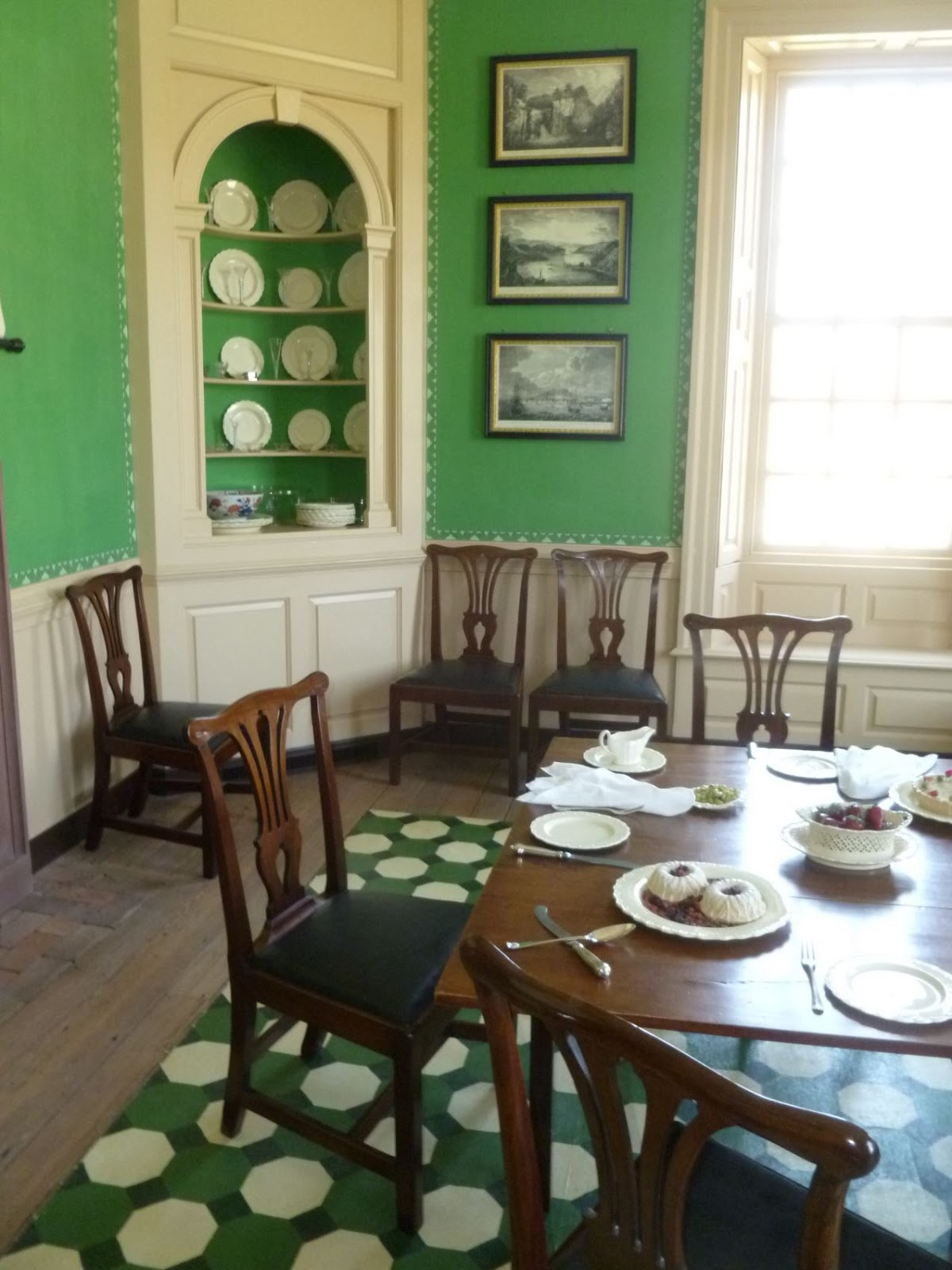
I don't recall if I've ever shared an image of the dining room in the Wythe House, but it is certainly eye-catching!  Even though it may not be my favorite decorating scheme, it has a tasteful charm that kind of grows on you.

Proof positive that Tara got a chance to play the reproduction harpsichord in the cabinetmaker's shop.

This little outbuilding caught my eye and reminded me of the playhouse I built several years ago for my daughters.  Not that our playhouse shared a lot of features with this building other than approximate size and proportion.

As the afternoon winds down and we realize these are our last moments on Duke of Gloucester Street for this trip, we can't pass up the opportunity for a fashionable shot of our lovely young ladies.  These memories will have to suffice until we can return again to Colonial Williamsburg.

Tuesday, April 9, 2013

Colonial Williamsburg 2013, Day 4

Our fourth day activities started with a visit to the silversmith, where the apprentice entertained our questions and offered significant insight into the use of precious metals in the 18th century.

This image shows some of our party in the retail store in the next room that primarily displayed jewelry and had chocolate for sale.  Strange combination?  I think they know their clientele well.

Wetherburn's Tavern had changed in subtle ways since we last visited, but retains many of the charms of one of the few original structures in town.  All of the objects in this private room (excepting the tablecloth) are 18th century antiques that appear to have fared well over time.

Another of the 88 original structures is the dairy behind the tavern, which is the building on the left.  The reconstructed smokehouse and well cover are the other structures in this photo.

On our tour of Peyton Randolph's home we discovered new wallpaper in a more gothic style than what had hung here previously.

Tara, Gretel, Karen, David, and Annette navigating road hazards on Colonial Street south of Nicholson Street.

The Mary Stith is used for some intimate music programs, and even the rear of the home displays considerable colonial charm.

The tailor has a new apprentice.  Michael told us a bit about himself, and then showed us the summer-weight men's suit he's working on.  I suspect we'll get to know him better in the future.

The wigmaker tried (in vain) to convince our ladies that a wig would be preferable to their natural hair.  Since we only pretend to live in the 18th century, we weren't buying her arguments, although the wigmaking process is pretty interesting and her finished products were very impressive.

Finally, a view of the Bruton Parish bell tower from across several yards and pastures.  Conveniently hidden from view is the scaffolding that surrounds most of the rest of the building to aid a current construction project.

Sunday, April 7, 2013

Colonial Williamsburg 2013, Day 3

Our third day was the Lord's day, which found us starting our day at Bruton Parish as has been our pattern for the last several visits.  I forgot my camera, so I don't have a picture to show, but our view from the balcony looked a lot like the image here.

Our afternoon tour of the town included a visit to the cabinetmakers who work in this charming little workshop.  Someone called our attention to the different roof materials on the two sections of the building, so we asked one of the cabinetmakers why the taller building got a new roof, and not the entire building.  We were told the lighter colored shingles are actually clay tiles that were installed in the 1960s!  Presumably the darker roof, which I believe has wood shingles, was installed after the clay tile roof, although no one explained why the two roofs are different.  Oh well, I guess we'll have to ask that question the next time we stop in.

This chest was constructed by the cabinetmakers, but it's not accessible to the public since it holds the tools of the workers and rests in their work area.  Now THAT'S a tool chest!

Sadly, the little garden we document on each visit looks about as bare as we've ever seen it.

Our afternoon took an interesting turn when Karen and I struck up a conversation with this young man that was practicing cricket bowling on the lawn of the Market Square.  Just a few hours earlier, a customed CW interpreter had invited us to a cricket match as we exited Bruton Parish; that interpreter happened to be this young man's father.  Levi Walker and his sister Annaiah (to his left) turned out to be two of five home-educated siblings that have lived with their parents on the property of Colonial Williamsburg for the last five years, currently residing in the home behind Levi which happens to sit directly east of the Peyton Randolph House.  Levi's dad, Brett, is a journeyman shoemaker that works in the shop on Duke of Gloucester Street, and is organizing an 18th century cricket match at Bacon's Castle on April 20.  The game will be played to 1755 rules, 18th century dress is expected for players and spectators, and vendors are encouraged to hawk their wares (which I assume will be period-correct as well).  If you're in the area on the 20th, head out to Bacon's Castle and check it out!

By late afternoon, the weather and lighting were ideal for a little fashion photo shoot.

Since lambing is in full swing right now, we've been scouring the city to find its newest residents.  We finally found these two siblings in the pasture to the north of the Blue Bell Tavern.  Even though sheep have a reputation for being stupid, these two lambs are still very cute.

While exploring behind the Blue Bell (yellow building in the background), we found this gazebo that I'd never noticed before.  This structure has several interesting features, one of which is the screens all the way around the structure, which makes it suitable for evening use in mosquito-infested Illinois.  I don't know that I'd call this gazebo my favorite in town, but it's definitely in my top five.

Finally, a rare shot of Karen and I courtesy of Kathryn.

Friday, April 5, 2013

Colonial Williamsburg 2013, Day 1

We are blessed to be back in Colonial Williamsburg again this April, although it appears that spring is as late coming to this part of the country as it is at home.  Our first day started wet after rain came through last night, so we decided to shop for antiques around town until our first Historic District activity in the afternoon.  The Vintage Rabbit and The Velvet Shoestring were both home furnishing consignment stores that displayed their wares attractively, but didn't convince us to purchase anything.  By noon the sky was clear, the temperature was warming, and our appetites were ready for the buffet at Nawab Cuisine.  The staff at Nawab did not disappoint us, confirming its status as the best Indian food on the East Coast (or at least Williamsburg).

After lunch we had time to visit a small antique store on our way back to the Historic District where we wandered through an exhibit of "Painters and Paintings in the Early American South" while waiting for a music program to begin.  The music program was 30 minutes of listening to a quartet on the harpsichord, viola de gamba, violin, and German flute playing short selections from a variety of 18th century composers, famous and not-so-famous.  The venue was a stark classroom in the DeWitt Wallace Museum, but the music was as inspiring as the venue wasn't, and still left us time for more antique shopping at the Williamsburg Antique Mall.

This was our view of the Capitol as we approached for the Capitol Concert this evening which consisted of an a cappella quartet singing madrigals from the 16th and 17th centuries.  The artists, Michael Monaco, Jane Hanson, Jennifer Edenborn, and Herb Watson, are all familiar to us, but in the past we've only heard Jane Hanson's singing as the others are usually busy with their instruments.

Sharp eyes and good memories will notice that the trim and cupola on the building have been painted a different color since our last visit.

This was my view of the singer's "music stand" for the concert.  Herb Watson was close enough I could have reached out and touched him -- we were definitely in the spit zone!  The House of Burgesses hall in candlelight makes a wonderful atmosphere for live colonial music, and the musicians tonight performed well enough to bring honor to the venue.

Sunday, September 30, 2012

English postcard #8

Fountains Abbey, North Yorkshire

I hope you don't mind if I continue to "send postcards" from England even though we're home by now.  I also hope you don't mind another picture from Fountains Abbey.  I thought this view was interesting in that four arches could be lined up and captured at the same time.  I don't think I'll ever tire of arched window and doorways, perhaps because they're so rare in our part of the world.

Thursday, September 20, 2012

English postcard #7

Broad Sanctuary, Westminster, London

These sites that I've seen many times in photographs really are bigger in real life.  I'm confident we're not in Tremont.

Wednesday, September 19, 2012

English postcard #5

Arlington Row, Bibury, Gloucestershire

William Morris called it "the most beautiful village in England," and I think he had a pretty good eye for beauty.  This row of cottages was built in 1380 as a monastic wool store and converted into a row of weaver's cottages in the 17th century.  Please ignore the satellite dish.

Friday, September 14, 2012

English postcard #3

Fountains Abbey, North Yorkshire

This abbey and the adjoining grounds of Studley Royal was one of the first historic sites Karen and I visited several years ago, but our girls had never enjoyed them.  The remaining structures of the Fountains Abbey grounds suggest a productive and prosperous community several hundred years ago.  One can only imagine the experience of visiting a place like this back then.

Wednesday, September 12, 2012

English postcard

Lyme Park, Cheshire

We don't have many buildings like this in Illinois, and those that are this big and ornate are government buildings built with our taxes.  This building however, is a home.  At least it was originally built as a home when construction began in the late 16th century, but was donated to the National Trust in 1946 so we can all tour it and enjoy it.  Jane Austen movie fans may recognize this building.

Tuesday, April 24, 2012

Colonial Williamsburg in April, Day 5

Our fifth day was a long and busy one that began with an attempt to squeeze into a garden tour at 9 AM.  When it was clear that the tour didn't have room for us, we consoled ourselves with a tour of the Thomas Everard House.

Although simply furnished, I thought this upstairs bedroom looked very comfortable and relaxing.  I like the way the natural light from the dormer window facing west provides the room with a soft glow.

I've been impressed with the woodwork on this staircase each time I've toured this house, but I don't think I had ever noticed the disparity in the balusters before.  Nonetheless, I still like this staircase.

I've shown a picture of Everard's office in a previous post, but this shot shows the other side of the room including a cool desk, beautiful drop-leaf table in the middle of the room, and allegedly a microscope inside the pyramid-shaped box by the window.

We had to go outside the house to see this, but someone (perhaps H.B. Smith?) scratched this ship in the glass of one the parlor window panes in 1873.  Actually, this is reproduction of the 1873 work, as the original was destroyed several years ago when a painter's ladder slipped and crashed through the window.  Remember that when you think you've done something unforgivable.

Three lovely ladies on a bench in a Palace courtyard.

The tranquil canal to the west of the Palace: one of our favorite spots to find solitude.

Things were not so tranquil in the Palace kitchen, but only because there's always food to prepare.

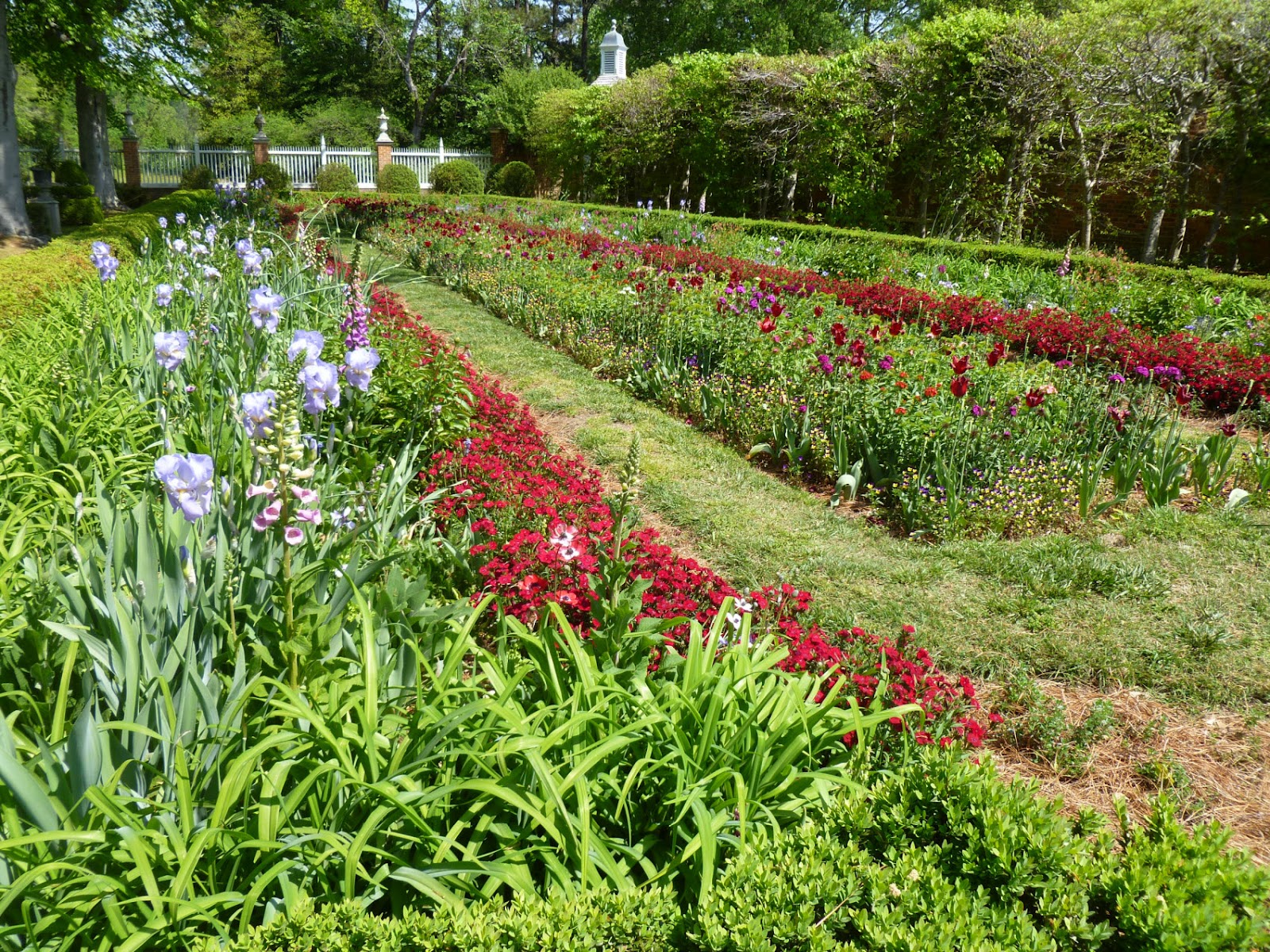
Although the tulips were fading by the end of our trip, the gardens were still beautiful with a variety of other flowers.

At lunch time our group split up again and I was fortunate enough to be joined by these three pleasant young ladies at Nawab Indian Cuisine for their hard-to-beat buffet.

This attractive little gate caught my eye along Duke of Gloucester Street.  I like the symmetry and the way the peaked shape mimics the peaked roof of the shed behind it.  So many fun architectural features, so little time.

We were honored to find Mark Hutter in the Millinery/Tailor Shop today, and as always, he educated us on several topics.  When asked about his current projects, he produced the bolt of purple fabric laying in front of him in the image above and proceeded to tell us about the 1740s suit they are planning to make from the fabric.  One of the few extant garments known to have been worn in Williamsburg in the 18th century was a man's suit crafted in three pieces (coat, waistcoat, and breeches) from a silk very similar to the bolt pictured.  Acting on behalf of Colonial Williamsburg, Mr. Hutter commissioned a European fabric mill to match the 18th century fabric.  The match is not perfect, as some fine details were omitted due to budget constraints, but I'm told most people would be hard pressed to tell the difference (since I haven't seen the original garments, I can't comment on this claim).

The original suit was worn by the owner and was later updated to 1770s fashion for use by the son.  Naturally, Mr. Hutter only has access to the modified garments, but can tell from their construction what the 1740s garment probably looked like.  His intention is to create two coats, both in the 1740s style, and then modify one of them to reflect the current state of the garment in the 1770s style.  In the image above Mr. Hutter was describing characteristics of the fabric pattern that made this fabric an interesting combination of two styles, and he had just finished describing the construction differences between 1740s and 1770s men's coats.  We were all very impressed.

Later, at the Cabinetmaker Shop, Elizabeth joined a long line of keyboard players that have practiced their form on this reproduction harpsichord.

This obligatory image shows a quaint garden we've enjoyed seeing here in different seasons.

Finally, after dinner at Aroma's (another favorite here), we made our way to the Palace for a candlelight concert featuring violins, viola, viola da gamba, flute, and harpsichord.  As always, the candlelit atmosphere suited the classical music well as the Governor's Musick ensemble played works composed by Carl Friedrich Abel, Joseph Haydn, Johann Christian Bach, and Leopold Mozart (Wolfgang's dad).  We always enjoy these concerts so much I have to wonder: would we attend frequently if we lived in Williamsburg?  There's only one way to find out!  It's good to be on vacation!

On day two I mentioned that we watched the filming of a live webcast on the streets of CW, and it appears that the webcast is now archived online, so we can all watch it at our leisure.  Go to http://connect.history.org/archived-webcasts and click on the link for "American Ideas: The Gale from the North."